tfbot
Convention-aware Terraform change automation — a self-hosted bot that turns a plain-English infra request into a convention-perfect, ready-to-review pull request. The model proposes a validated intermediate representation; deterministic Go performs the edits.
Where this came from
A lot of my infra change during my Samsung co-op followed the same tiny liturgy: grab a JIRA ticket, open the Terraform repo, hunt down the file where that kind of resource usually lives, copy the block above it, change five values, match the naming scheme from memory, open a PR, wait for Atlantis to plan, notice I fat-fingered one label, push again, wait again.
None of it was too hard. All of it was rote. It was the software-engineering equivalent of hand-copying a recipe because the cookbook is chained to the desk — and I kept thinking a small, very stubborn robot could do the copying while I kept the only part that needs a brain: the review.
tfbot (working name; it changes with my mood) is that robot.
What it does
You give it a sentence or a JIRA ticket (lol). It gives you back a pull request.
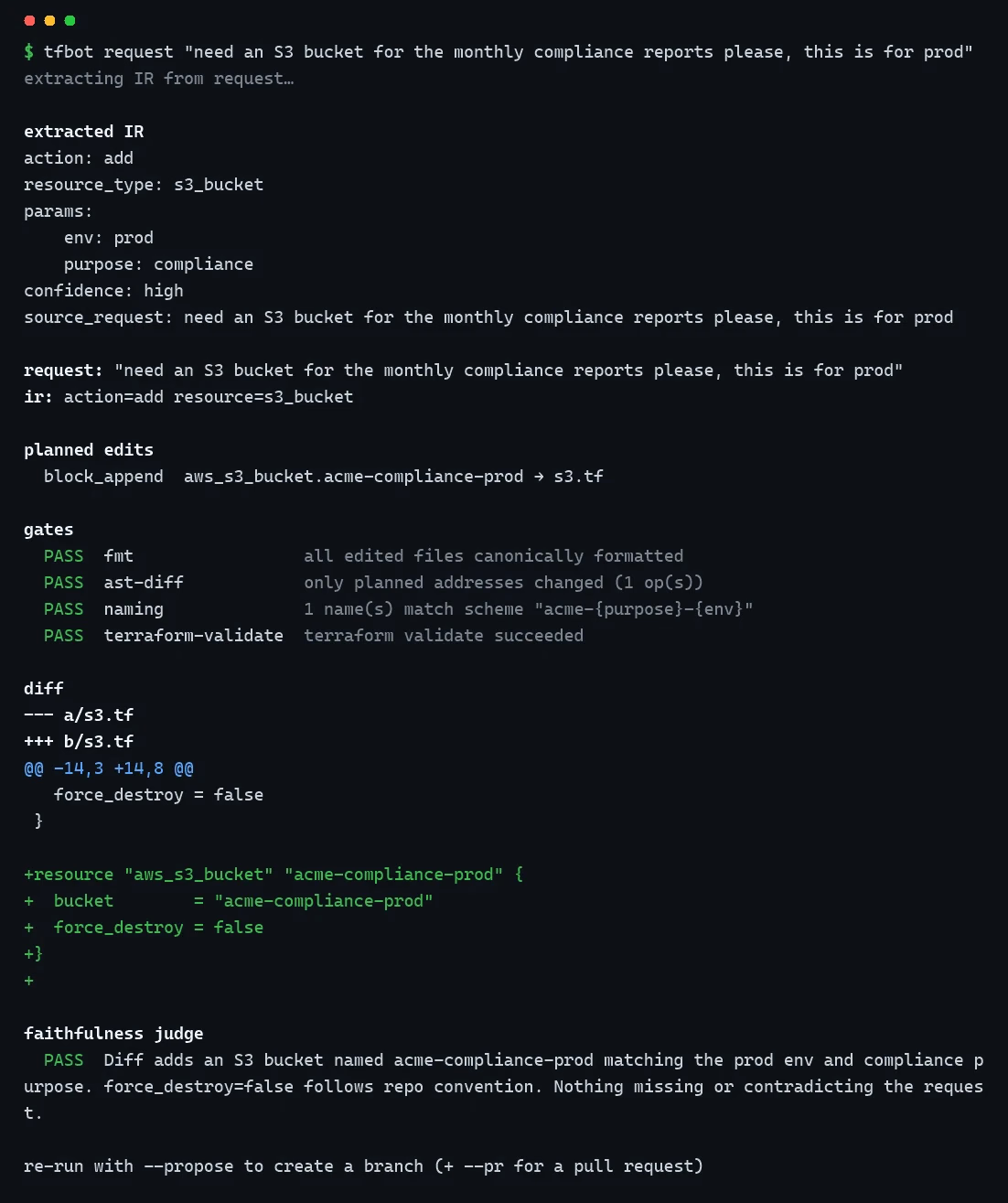
“need an S3 bucket for the monthly compliance reports, this is for prod”
That turns into a branch with a convention-perfect Terraform block, four gates green, a terraform plan running async in CI, and the reasoning stapled to the PR description. You review it and merge — or tell it it’s wrong, which is a first-class outcome, not an error.
Here it is doing the whole loop, live and unedited:

The one rule everything else hangs off
The LLM proposes; deterministic code performs.
The model is never allowed to write HCL. Letting a language model freehand your infrastructure files is how you get a bucket that’s 90% right and 100% unreviewable. Instead, the only thing that crosses the AI boundary is a small, schema-validated intermediate representation — a structured “here is what I think you asked for”:
action: addresource_type: s3_bucketparams: env: prod purpose: complianceconfidence: highA Go engine takes that IR and makes the edit surgically, on the syntax tree, with hclwrite. It never regenerates a file from a template. Your existing comments, your slightly cursed block ordering, that one hand-aligned column you’re irrationally proud of — all of it survives byte-for-byte. (There is a test literally named TestApplyAddPreservesExistingBytes, because I trust myself about as far as I can throw a Terraform state file.)
Conventions are data, not code
Every Terraform repo has a house style: whether buckets are raw resources or a module, which file they live in, how things get named, which defaults everyone copies without thinking. tfbot learns all of that before any AI shows up. A zero-LLM, offline scanner reads the repo and drafts a recipe.yaml — the conventions written down as data, ratified once by a human:
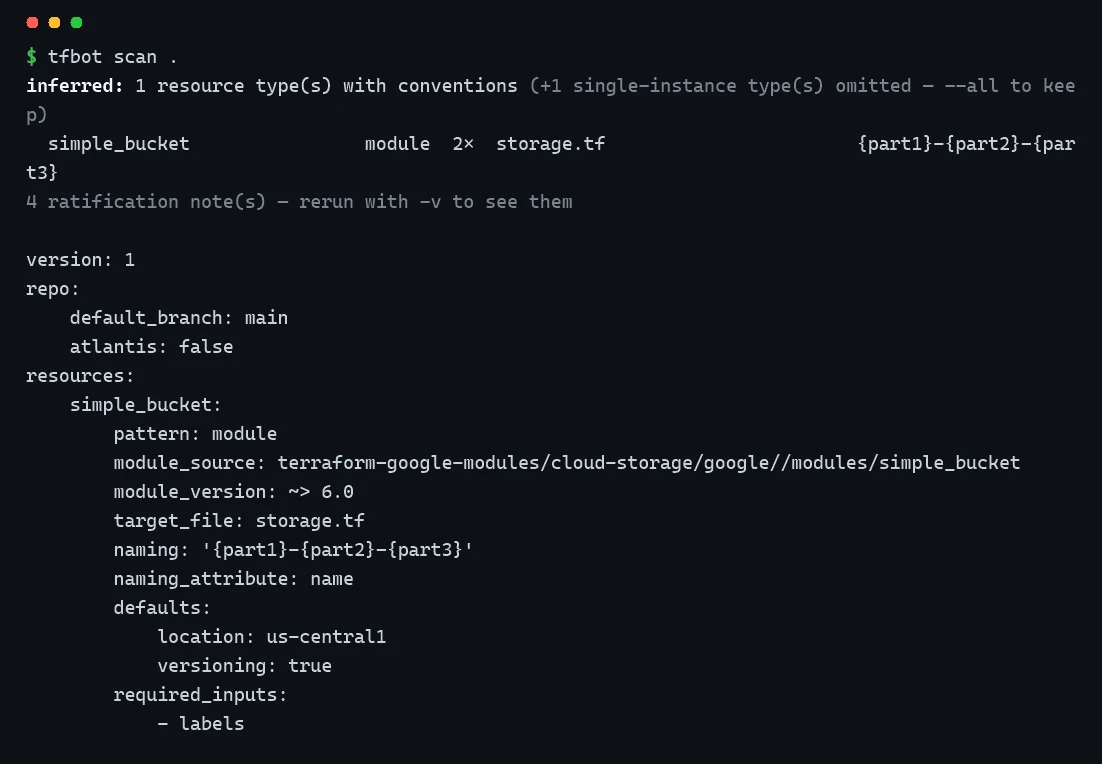
tfbot scan . on a GCS repo — one command, about a second, no network. It infers the module source, target file, naming scheme, and shared defaults, then hands you a draft recipe.yaml to sign off on. Placeholders like {part1} stay deliberately dumb; naming things is the one job it refuses to guess at.
That recipe drives a single generic executor. Adding support for a new resource type is a new recipe entry, not a new if branch — so the interesting engineering lives in the inference, not in an ever-growing switch statement I would eventually learn to hate.
Two AI steps, and a wall of boring checks between them
The whole pipeline gives a model a say in exactly two places: extraction at the start (sentence → IR) and one faithfulness judge at the very end (does this diff actually match what was asked?). Everything in between is deterministic gates that cannot be sweet-talked:
- fmt — is every edited file canonically formatted?
- ast-diff — did only the addresses we planned to touch change? (This one hard-fails the run if the model colored outside the lines.)
- naming — does the new block match the repo’s scheme?
- terraform validate — does it actually validate?
And when a gate can’t run — no terraform binary, uninitialized workspace — it returns Skip with a reason, never a fake pass. Gates degrade honestly or not at all, so the synchronous path works fully offline. The judge can veto; it can never edit. No agents grading agents, no vibes, no “looks good to me 🤖”.
My favorite part is what it does when you’re vague. Ask for “another bucket like the analytics one” and it doesn’t guess — it asks you a few questions and touches nothing. Refusing to make something up was a feature I had to build on purpose, and it’s the one I’d defend hardest.
Same engine, any cloud
Because provider knowledge is consumed (terraform providers schema -json) rather than hand-coded, going from AWS to GCP to whatever-comes-next is mostly free. Same request flow, same gates, a different module block falling out the bottom:
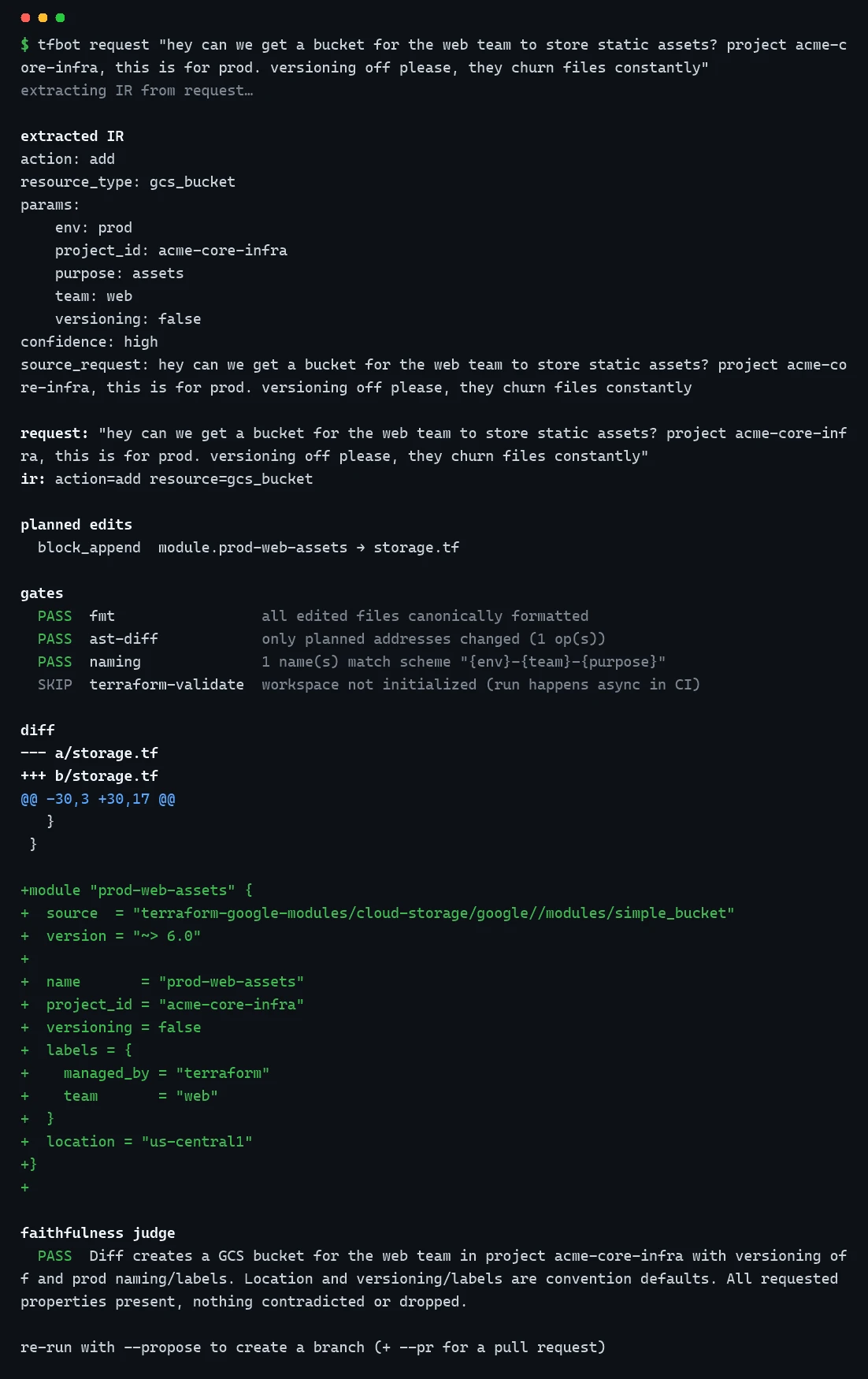
The same sentence-to-diff flow against a GCS repo — a module block instead of a raw resource, and terraform-validate honestly reporting Skip because the workspace isn’t initialized. The real plan runs async in CI, where it belongs.
What it is, and where it’s going
Right now it hangs together as a vertical slice — a CLI, a local web UI, and a GitHub webhook where a /tfbot <request> comment on an issue comes back as a pull request. It’s honestly still a workbench more than a product: I’m poking at it in the open, mostly to find out which of my assumptions actually survive contact with a real repo. Human review and Atlantis apply stay exactly where they already are — the aim was never to take people out of the loop, only the tedium.
The part I’m most curious about is still ahead of me: whether a small, self-hosted model can handle the extraction step about as well as a frontier one — because self-hosted, and your repo stays yours is the pitch that actually matters, and cost is just the bonus. That might mean renting a GPU for an afternoon to fine-tune something with QLoRA, or it might just mean pointing a good open-source model at the IR schema with grammar-constrained decoding and seeing how far honest prompting gets on its own. Either way there’s a benchmark waiting at the end — and I’d rather publish the one where the small model loses a couple than the one that’s secretly just a screenshot.
The nice part is the deterministic half doesn’t care which model wins that experiment: the gates, the AST surgery, the recipe all stay exactly the same. The model is the one swappable piece, which is precisely where I want the uncertainty to live. For now it already does the boring 90% and leaves me the 10% worth doing — and back when that boring 90% was the whole Tuesday, that’s a trade I’ll take.